
LearnMCP: Vibe Learning for the Agentic Era
I built LearnMCP, an open cartridge-based learning system for Claude Code that recognizes best practices as you build, no dedicated study time needed.
Every developer I know is building inside an agent now, and so is a growing number of people who'd never call themselves developers. Claude Code, an MCP server, a prompt instead of a blank file, that's just how work gets done in the agentic era. Nobody schedules time to sit down and learn these tools properly first. You start building and pick up what you need along the way, if you're lucky enough to pick up the right things at the right time.
That's the gap I built LearnMCP to close: a new kind of LMS, one that teaches you while you build instead of before you start. It's a free, fully open source Claude Code plugin that watches what you do and rewards you for it, passively, in the background, tied to no single vendor. It doesn't care whether you're using Postman, Supabase, GitHub, or a tool I've never heard of. It also doesn't just look backward: it notices what you haven't tried yet and surfaces the next thing worth learning, so you're not just getting credit for what you did, you're getting pointed toward what to do next. It's live right now.
claude plugin marketplace add quintonwall/learnmcp
claude plugin install learnmcp@quintonwall
Restart Claude Code and that's it. No account, no API keys, nothing to configure. As you work, it recognizes when you've done something worth rewarding: generating an OpenAPI spec might earn you a "Spec Author" badge. Points climb toward ranks from Novice up to Legend, with bronze, silver, and gold tiers along the way, and use /learn, /badges, /progress, or /cartridges any time you want to check what you've earned or what's next. It works anonymously out of the box, claiming a handle for the leaderboard is optional, and if you'd rather not send anything to the cloud at all, set LEARNMCP_LOCAL=1 and it stays entirely on your machine, or self-host it. Full source is on GitHub.
I've been circling this idea for over a decade. Here's where it actually came from.
The Medals idea that became Trailhead
I have an undergrad in Organizational Behavior and Adult Learning, so it's not exactly a surprise that I've spent most of my career obsessed with how people learn. DevRel is basically that degree with better swag. You're constantly teaching something new, and if you're good at it, you're constantly learning yourself.
In 2014 I was part of developer relations at Salesforce, and one of my fellow advocates, Josh, had an idea. What if you could use the platform's own APIs and metadata to check whether someone had actually completed a learning exercise? Not a quiz. Not a "mark this module complete" button. The platform itself would tell you if the org had the fields, the flows, the automation you were supposed to build.
We called them Medals. We ran them at meetups and hackathons, and the whole point was that it felt like a game, not homework. That idea shipped, got polished, and turned into Trailhead. It didn't take long. What started as a fun thing advocates did at events became one of the biggest developer education platforms in the industry, mostly because it was a better, more fun experience than reading a PDF and hoping you understood it.
Liftoff takes the idea further at Postman
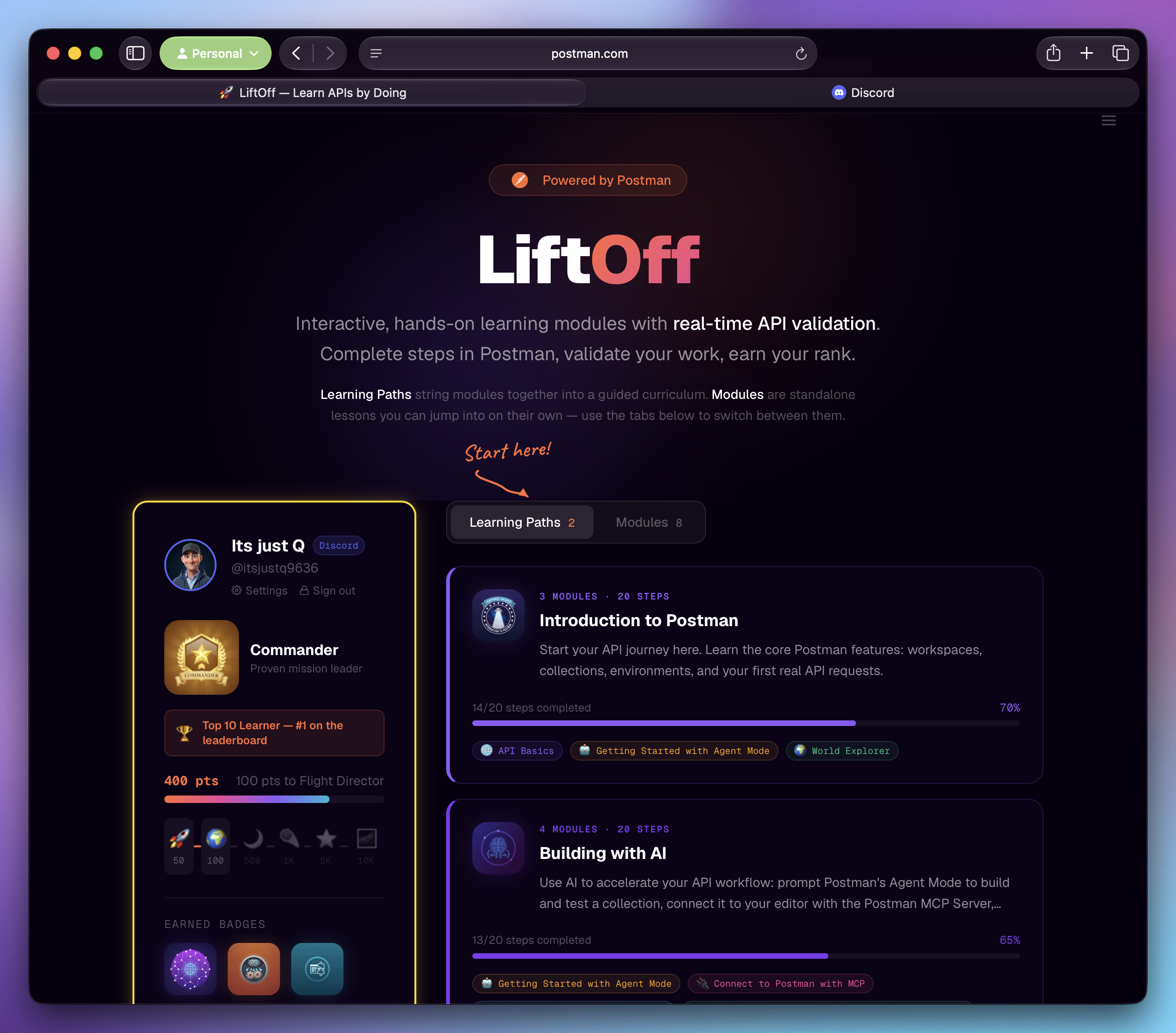
Trailhead proved the model. Validate real work with real APIs, wrap it in something that feels like progress instead of a syllabus, and people show up. I carried that same belief with me to Postman, where I built Liftoff, and it's honestly the best version of this idea I've built so far.
Every module validates against Postman's own APIs in real time, so you know the moment you've actually got something right instead of hoping a quiz graded you fairly. AI generates the modules themselves, so new content isn't stuck waiting on a team of instructional designers every time Postman ships something new. And the whole loop feeds back into Discord, where developers already hang out, so if you get stuck on a module you can just ask the community instead of quietly giving up. Finish a module and Liftoff DMs you, recommending the next module or learning path to tackle, so you're never staring at a dashboard wondering what to do next. Real API validation, AI-generated content that keeps pace with the product, and a community loop that actually pulls people back in: that combination is what makes Liftoff work. It's close to launching and I'm genuinely excited about it.
Building it also taught me something, not a flaw in Liftoff, but a property of any platform-specific system like it or Trailhead: you still have to set aside time and open the tool. That got me thinking more broadly about where developer learning goes next, given how fast AI is moving.
What vibe learning actually means
Vibe coding, the term Andrej Karpathy popularized in early 2025, describes writing software by telling an AI what you want instead of typing every line yourself. I kept coming back to an obvious question: if that's how people build now, why is learning still stuck in the old model, where you stop what you're doing, open a separate app, and go "learn"?
People have used "vibe learning" before me, including a Forbes Business Council piece and an arXiv paper on education in the age of AI. Every version I've found still means sitting down and actively chatting with an AI, just more conversational than a textbook. That's still active learning, and I think it's the wrong definition.
That's not what I built. I wanted something that happens beside the work you're already doing, not instead of it. No dedicated session, no opening a separate learning app. You're building with an MCP server in Claude Code because that's your job today, and the system quietly notices what you did and teaches you the next thing in that moment, not three weeks later in a course you signed up for and forgot about.
This connects to something I wrote a few months back in The Future of DevRel: Let a Million Ideas Bloom. My argument there was that AI already solved the job DevRel used to do, teaching people to write code, and that the real job now is helping a much bigger, less technical group of builders ship something that works. If that's true, how we teach has to change too. You can't onboard a bigger, busier, less technical crowd with a thirty-module course. You have to meet them where they're building, which for most developers right now is inside an agent.
Cartridges: open, hot-loadable learning modules
Trailhead and Liftoff both earn their validation the same way: by being deeply wired into one company's APIs. That's exactly why they work as well as they do, and it's not something I'd change about either one. But it does mean the catalog comes from one team, Salesforce for Trailhead, the Liftoff project for Postman.
I wanted to try the opposite: a system where anyone could teach a tool into it, not just the company that built it. With axrank.ai, I already built something in that spirit, a system where anyone can submit an eval that grades how well an AI agent can use a company's developer surface. I took that same "let anyone submit the thing" idea and applied it to learning, then pushed it further with a plugin-style architecture: a cartridge.
A cartridge is a learning module built around a specific MCP server. Point the generator at an MCP server's docs, and it produces the recognition rules, the badges, and the point values automatically. You don't hand-write a course. The cartridge drops into a directory and hot-loads, the same way you'd install a plugin. I've already generated cartridges for the most popular MCPs, and you can see all of them at learnmcp.ai/cartridges. If your favorite MCP server isn't covered yet, submit one.
Where this goes next
I still don't fully know how far this idea scales. Trailhead needed a company behind it. Liftoff needs Postman's APIs. LearnMCP needs a community willing to write cartridges for MCP servers I haven't thought of yet. That's the bet. If it works, learning stops being something you schedule and starts being something that just happens while you build.
If you want to follow along, subscribe at quintonwall.com and catch the build-in-public stuff on YouTube at @seeqcode.
Subscribe
New posts on AI, developer relations, photography, and the odd long walk, straight to your inbox. No spam.