
What 8.9M Claude Code Plugin Installs Actually Tell Us
I pulled the official Claude Code plugin install stats and ran the numbers. The most-installed plugin isn't a coding tool, and the language server data is an accidental census of what developers actually build with.
Anthropic quietly publishes install counts for every plugin in the official Claude Code marketplace. It sits on a stats branch in the claude-plugins-official repo as a plain JSON file, no dashboard, no blog post announcing it. I pulled the snapshot generated on July 24, 2026 and spent an afternoon in it.
561 plugins. 8,893,403 all-time unique installs.
I went in with a guess about what would be on top. I was wrong, and being wrong turned out to be the interesting part. The list isn't really a ranking of tools. It's a ranking of the things developers can't get an AI agent to do well on its own, and once you read it that way it says something fairly uncomfortable about where we are.
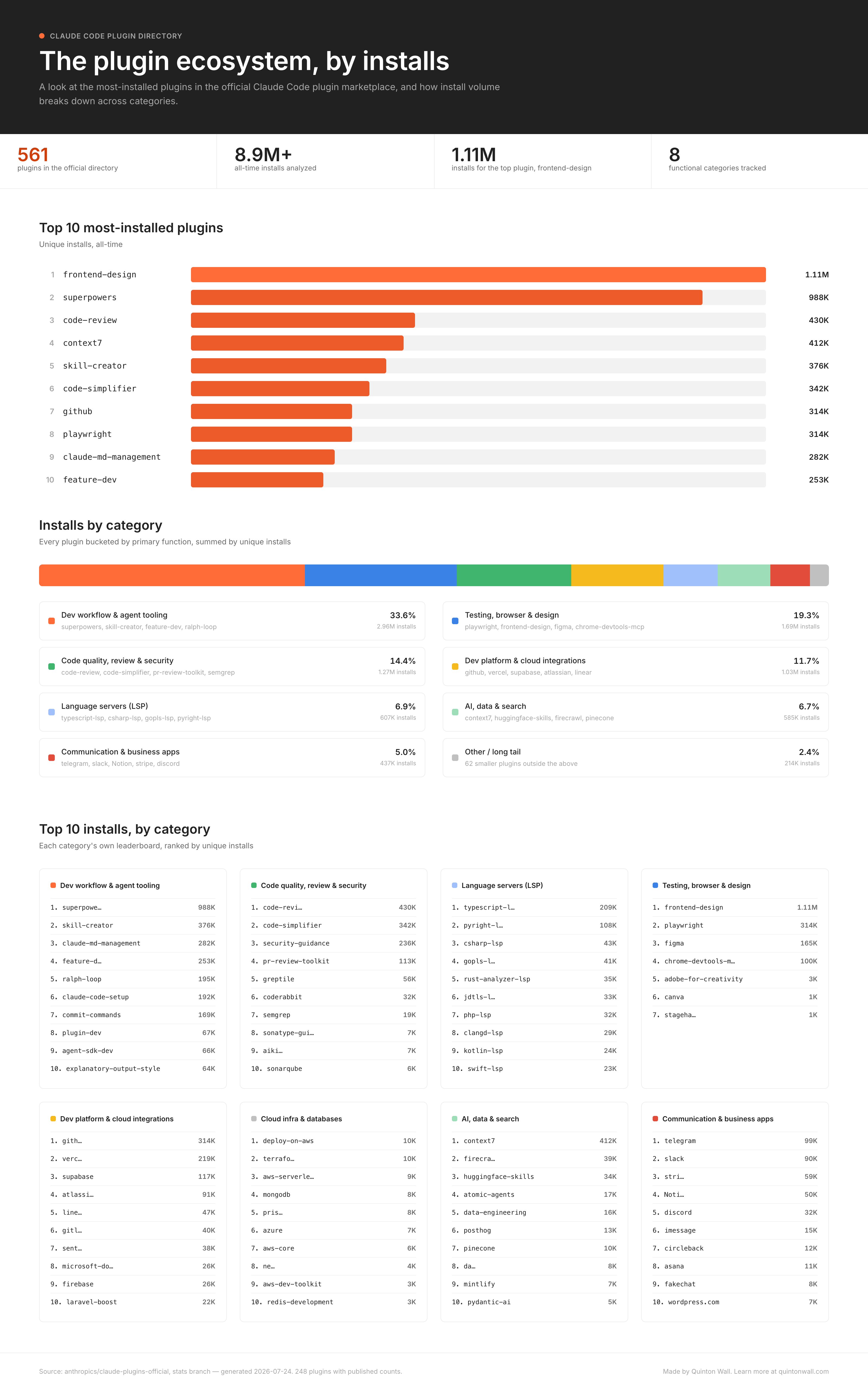
561 plugins, 8.9M installs, broken down by what each plugin is actually for
The most-installed plugin isn't a coding tool
Number one is frontend-design with 1,110,438 installs. That's 12.5% of every plugin install in the ecosystem, and it beats the number two by more than 120,000.
It doesn't generate code you couldn't get otherwise. Claude will happily write you a React component without it. What it does is shape the aesthetic decisions: spacing, type scale, color, the hundred small judgments that separate a UI that looks designed from one that looks generated. It's a taste plugin.
A million developers went out of their way to install taste. Think about what that means. The code generation is good enough that it's no longer the constraint, so people started spending their configuration budget on the layer above it. The complaint that AI-built interfaces all look the same turned out to be the single most-fixed problem in the entire marketplace.
It gets more pointed when you group the related plugins. frontend-design, playwright at 313,808, figma at 164,735, and chrome-devtools-mcp at 99,626 add up to 1,688,607 installs. That's 19% of the whole ecosystem devoted to the visual loop: making it look right, then letting the agent see whether it actually does. Nothing else comes close as a single theme.
The second-biggest job is checking the agent's work
Add up code-review (430,450), code-simplifier (341,666), security-guidance (235,822), pr-review-toolkit (113,300), greptile, coderabbit and semgrep, and you get roughly 14% of installs whose entire job is inspecting code that already exists.
Four of the top twelve plugins are verification tools. None of them help you write anything.
This is the quiet story of the last year of agentic coding. Generating code stopped being the bottleneck and reviewing it became one. When an agent can produce 400 lines in a minute, the scarce resource is your confidence that those 400 lines are correct, and a million-plus developers have voted with their install commands. I've felt this in my own work, and I wrote about why the review loop matters more than the build loop before I saw any of this data. Nice to be right about something.
A seventh of all installs are people configuring Claude Code itself
Here's the group I didn't expect. skill-creator (376,492), claude-md-management (282,075), claude-code-setup (191,507), plugin-dev (66,811), agent-sdk-dev (66,007), mcp-server-dev (32,654), hookify (59,624), remember (49,814).
Bundle those with the output-style plugins and you get about 14.7% of all installs from just twelve plugins whose product is Claude Code. Not your app. The tool.
Compare that to the 24 vendor integrations I could identify (github, vercel, supabase, stripe, Notion, linear, sentry, slack, datadog and the rest), which together pull 17.3%. Twelve meta-plugins nearly match twenty-four integrations with the entire SaaS industry behind them. Per plugin, the meta layer wins by roughly two and a half to one.
Developers are more interested in customizing their agent than connecting it to their stack. That's a genuinely new behavior. Nobody spent this much energy configuring their IDE.
The language server data is an accidental census
This is my favorite thing in the file, and I don't think it was meant to be there.
The marketplace carries a language server plugin for basically every language, and each one is a near-pure signal of what people are building. You don't install gopls-lsp unless you write Go. So the install counts are an unusually honest survey of what developers actually point Claude Code at:
| Language server | Installs |
|---|---|
| typescript-lsp | 209,264 |
| pyright-lsp (Python) | 108,029 |
| csharp-lsp | 43,074 |
| gopls-lsp (Go) | 41,095 |
| rust-analyzer-lsp | 35,438 |
| jdtls-lsp (Java) | 33,275 |
| php-lsp | 32,396 |
| clangd-lsp (C/C++) | 29,418 |
| kotlin-lsp | 23,751 |
| swift-lsp | 23,070 |
TypeScript is nearly double Python. In an ecosystem this AI-centric I assumed Python would lead comfortably, and it doesn't come close. That fits the frontend-design result: the center of gravity for AI-assisted coding right now is web application work, not model training.
The other thing worth staring at is Ruby, at 8,760. It's a fifth of PHP. Rails is very much alive and this data says its developers either aren't using Claude Code or aren't reaching for a language server when they do. I'd love to know which.
Swift at 23,070 also caught me off guard, sitting just behind Kotlin. Mobile is quietly using this stuff more than the discourse suggests.
The tail is genuinely brutal
Every marketplace is a power law and this one is steeper than most. The top 10 plugins take 54% of all installs. The top 20 take 74%. The top 50 take 91%.
The median plugin in the official directory has 96 installs. Not 96,000. Ninety-six.
376 of 561 plugins have under 1,000 installs. And 246 of them, nearly 44% of the directory, have exactly one install, which is almost certainly the author testing their own work. There's a plugin called silince-gutnebrg-builder in there with a single install, and something about that is both funny and a little sad.
If you're thinking about publishing a plugin, this is the number that matters. Being in the official directory buys you approximately nothing. Distribution comes from being genuinely useful for a problem lots of people have, and the top of this list is what that looks like.
Where I'd push back on my own analysis
Two caveats I want to be straight about.
These are cumulative all-time unique installs, not active usage. A plugin installed once in January and never invoked since counts the same as one someone runs forty times a day. There's no retention signal in this file at all, and I'd bet real money the ranking would reorder if there were.
Placement also matters. Plugins that surface prominently in /plugin discovery have an obvious advantage over ones you have to know the name of, so some of frontend-design's lead is distribution rather than pure demand. It's still a million installs, but I wouldn't read the exact ordering of the top five as a clean popularity contest.
What I actually run
For what it's worth, my own setup overlaps the top ten more than I expected: code-review, skill-creator, claude-md-management, and context7 (412,076 installs, sitting at number four) because a model's knowledge cutoff is a real daily problem and pulling current docs into context fixes it. I use postman at work, which sits at 19,957 in this data, in the honest middle of the pack.
The thing I'd tell anyone starting out: don't install twenty plugins. The data says the winners solve one specific failure mode each, and the failure modes worth fixing first are the same for almost everyone. Your UI looks generic. You can't tell if the generated code is right. Your agent doesn't know about anything released after its cutoff.
Fix those three and you've got most of what 8.9 million installs are collectively reaching for.
If you liked this, subscribe at quintonwall.com and come find me on YouTube at @seeqcode, where I get into Claude Code setups and the agent tooling I'm actually shipping with.
Subscribe
New posts on AI, developer relations, photography, and the odd long walk, straight to your inbox. No spam.