Learning the right AI balance
I'm still finding the right balance with AI. So far: let it be the laborer for logic and heavy lifting, and keep the craft and the art, the passion and the emotion, for myself.
I was awake early this morning, which is when I practice guitar. I was fingerpicking an acoustic tune and scrolling YouTube for lessons and songs to learn next. The feed was littered with AI-generated content, all of it trying to teach me tabs and fingerpicking patterns.
That's not what I was looking for. I wanted to learn how to play with emotion, how to be present, how to create something.
AI has its place. I'm still figuring out the right balance and I struggle with it daily, but I've learned a few things that shape how I approach it.
Where AI automation works: code, reviews, and numbers
AI is great at anything that is logical to the core. Code is ones and zeros. Math is numbers. Conversion statistics are, well, statistics. These problems have answers you can check. A test passes or it doesn't, and a review comment is right or it's wrong. When I hand a code review to an agent, I can verify what comes back, and that feedback loop is what makes automation safe here. It's why I'm comfortable letting AI do so much of my engineering work.
Hands, head, and heart
I once heard a saying that I can't shake. A person who works with their hands is a laborer. A person who works with their hands and their head is a craftsman. A person who works with their hands, their head, and their heart is an artist.
I think it's the cleanest way to sort what I should and shouldn't automate, because it tells me exactly what AI is in my work.
AI is the laborer
AI is the hands. It tightens a sentence, catches a typo, scaffolds a demo, formats a table, runs the review, and it does all of it tirelessly.
It has no head or heart of its own. It has never been somewhere and been changed by it. It hasn't shipped something that broke at 2am, or stood on a trail at sunrise and forgotten to breathe. Whatever head and heart show up in the work have to come from me.
Craft requires passion
Craft is hands plus head. A narrative piece, a technical demo, a blog post. The head is the experience, the opinion, the point of view you earned by doing the work badly for years before doing it well.
That takes passion, and passion isn't something you can delegate. If I hand AI the thinking, what comes back may be competent. It won't be mine, and it won't be worth much to you, because you could have asked the same question and gotten the same answer.
So I keep the thinking. I write the notes, work out what I believe, and decide what the piece is about. Then AI gets the labor.
Art requires emotion
Art is hands, head, and heart. Music, photography, painting, creative writing. It's human expression of emotion in its purest form, and that's what I'm fiercely protecting and keeping free from AI.
When I make a photograph, the whole point is that I was standing there, I felt something, and I pressed the shutter. Generate that and you may get a prettier picture, but there's nobody inside it.
When I was trying to make my way as a professional photographer, I came to believe that people buy prints for one of two reasons. The first is inspiration. They want to go to that place and experience that sight or that moment. The second is memory. They were once there, and the photo takes them back. Either way, they feel something. They're buying the feeling. I think that's true of any artwork.
And a feeling is the one thing a generated image can't carry, because nobody felt it first. The same goes for the guitar. The notes were never the point.
I need to keep reminding myself of this. The tools are good enough now that it's easy to say "just this once" about the creative stuff, because the result looks fine. Fine is the trap.
AI is never your muse
If AI is the laborer, it can't also be the muse. I think this is where people slip.
Imagine Johnny Cash without June Carter. Or Andy Warhol without Edie Sedgwick. Or Jane Austen without Tom Lefroy. Take those people out and the work is different, maybe gone.
Imagine if June Carter used AI when she wrote Ring of Fire:
You are an award-winning country songwriter. Write song lyrics about
falling in love with a man who is bad for me. Make it relatable and
upbeat, under 3 minutes, radio friendly. Include a fire metaphor and a
hook that tests well with Gen Z. Add a key change.
I ran that exact prompt through Claude. It came back with a song called "Red Flag Country," complete with verses, a bridge, a key change from G to A, and a spoken outro. This is the chorus:
He's a red flag, but he's my favorite color,
Strike a match, baby, light me like no other.
I know I should run, but I'm a moth and he's a flame,
Burning down the good sense with his name.
It's giving "bad idea," it's giving "so worth it,"
Say I'm in my villain era and I'm perfect for it.
He's a red flag, and I'm waving it high,
Lord, I'm gonna love him till the whole town's on fire.
Honestly, it's good. It rhymes, it's catchy, and it hit every item on my list: the fire metaphor, the Gen Z hook, the key change. It would probably test well. That's the problem. It's a bad-boy song built from the average of every bad-boy song, trimmed to my brief. The woman in it picks the fire and waves the flag. Nobody in it is scared, and nobody pays for it.
"Ring of Fire" is different. June Carter and Merle Kilgore wrote it in 1962, and June wrote it out of her conflicted feelings about falling for Johnny before they were married. You can hear that she didn't know how it would end. You can't prompt your way to that.
A muse changes you. They're a real person with their own life, they have something at stake, and meeting them leaves a mark you carry into the work. AI has nothing at stake. It won't break your heart or leave you rattled in a way you have to get onto a page. It will happily hand you a blended average of everything it's read, and call that inspiration.
So I use it for the labor and go find the inspiration somewhere else. A trail, a conversation, a person, a song at 5am.
Why I'm okay doing less
AI can make me so productive. I can ship more, faster, across more projects than I could have a couple of years ago. But the more time I spend thinking about it, the more I'm okay with doing less. I'd rather produce a smaller amount of work that brings a unique perspective into the world than a pile of work anyone could have generated.
Passion and emotion are what make me, and what I create, unique and valuable. Everyone has access to the same laborer now. What nobody else has is my head and my heart, so those are the two things I'm not willing to outsource.
Where I haven't figured it out yet
I'd be lying if I told you I've got a clean rule. I don't. Here are three examples of where the line gets blurry for me, and there are plenty more.
Databases first. I've never been great at database skills. With AI I can write stored procedures and triggers without much trouble, and that lets me build more, faster. I'm comfortable with that one. It's logic with checkable answers, and the laborer is doing laborer work. I'd rather ship the app than pretend I enjoy writing triggers.
User interfaces bother me. I build websites with AI, and they look great. They also look like every other website built with the same trained model, something I wrote about in Every AI App Looks the Same. An interface is a place where a person's taste is supposed to show up. So maybe I shouldn't be building the UI at all. Maybe it's okay that I don't have those skills. Maybe the right move is to partner with an artist, a graphic designer, and create a unique web experience together, even if it takes longer.
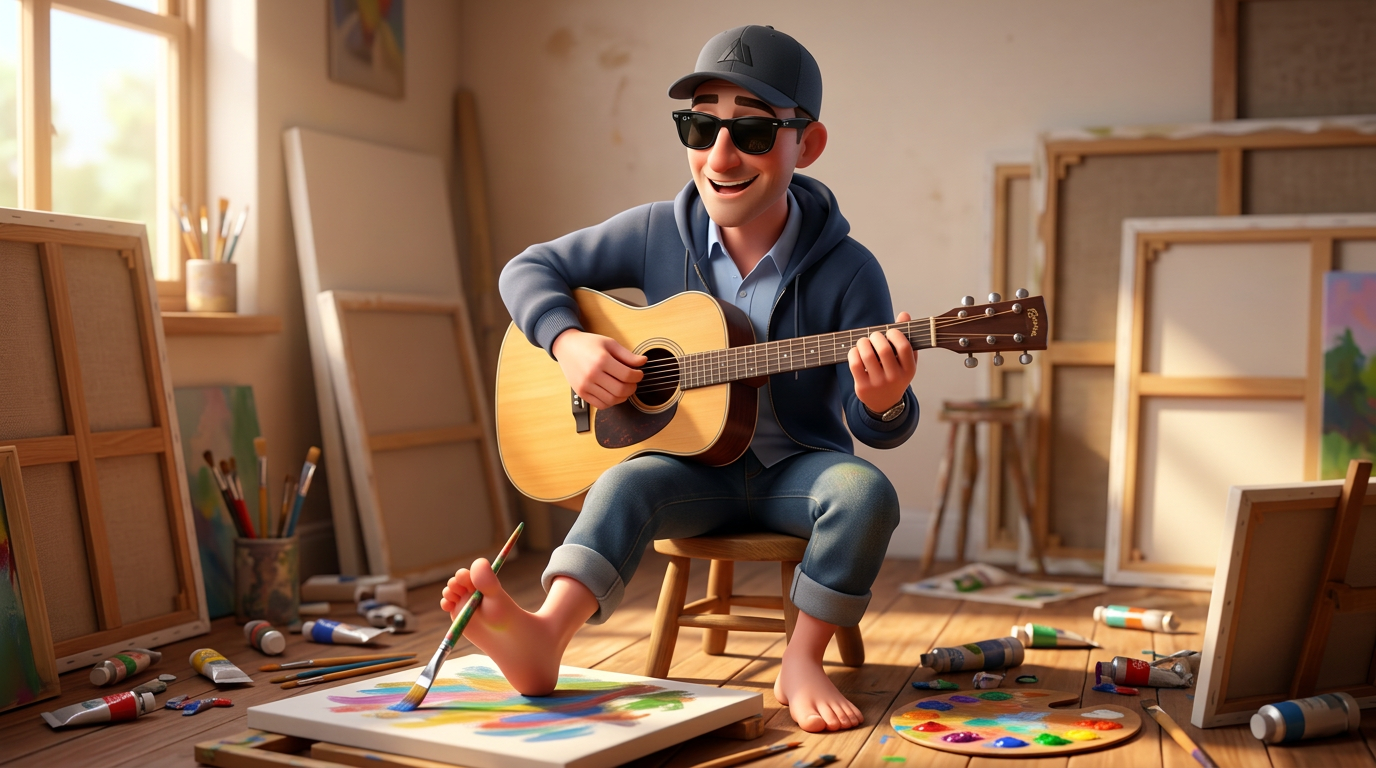
Then there's the header image. The image at the top of this post is a cartoon of me playing guitar and painting with my feet, and I generated it with AI. I don't have the ability to paint or illustrate something like that myself, and I needed a header image. It's not my art, and it isn't pretending to be. But it's another place where I picked the tool over the craft, and I can see how easy it would be to slide further down that road.
Where's the line between using a laborer for something I can't do and handing off something I should be doing? Databases feel fine, interfaces feel wrong, and I'm still sorting out the image. I don't have the answer yet, and I'm working it out in public, post by post.
The Art of Software Engineering
What I keep coming back to is the old name. I've been building apps long enough to remember when it was called the Art of Software Engineering. We called it that because the best of it was never only logic. There was taste in it, and judgment, and a bit of heart in how you structured a thing nobody would ever see.
AI can take the logical parts, and it's welcome to. I'd like to keep the art.
Subscribe to the site at quintonwall.com for more, and hit reply on the newsletter if you've found a balance that works for you. I'd like to hear where you landed.
True to my word, I wrote a page of notes for this post, collecting and organizing my thoughts, before giving it to AI to copyedit. I used AI as the laborer. When it comes to writing, I don't want AI doing my thinking (the craft), just the labor. The header image is the one exception: I generated it with AI because I don't have that art or craft ability.
Subscribe
New posts on AI, developer relations, photography, and the odd long walk, straight to your inbox. No spam.